
Model and cut
Manage product type, fit, sleeves, collars and complementary components.
 TRLet’s talk
FASHION, TEXTILES AND UNIFORMS
Combine fabric, colour, cut, panels, collars, sleeves, graphics and personal details in one product experience. We tailor the flow from collection selection to team ordering.
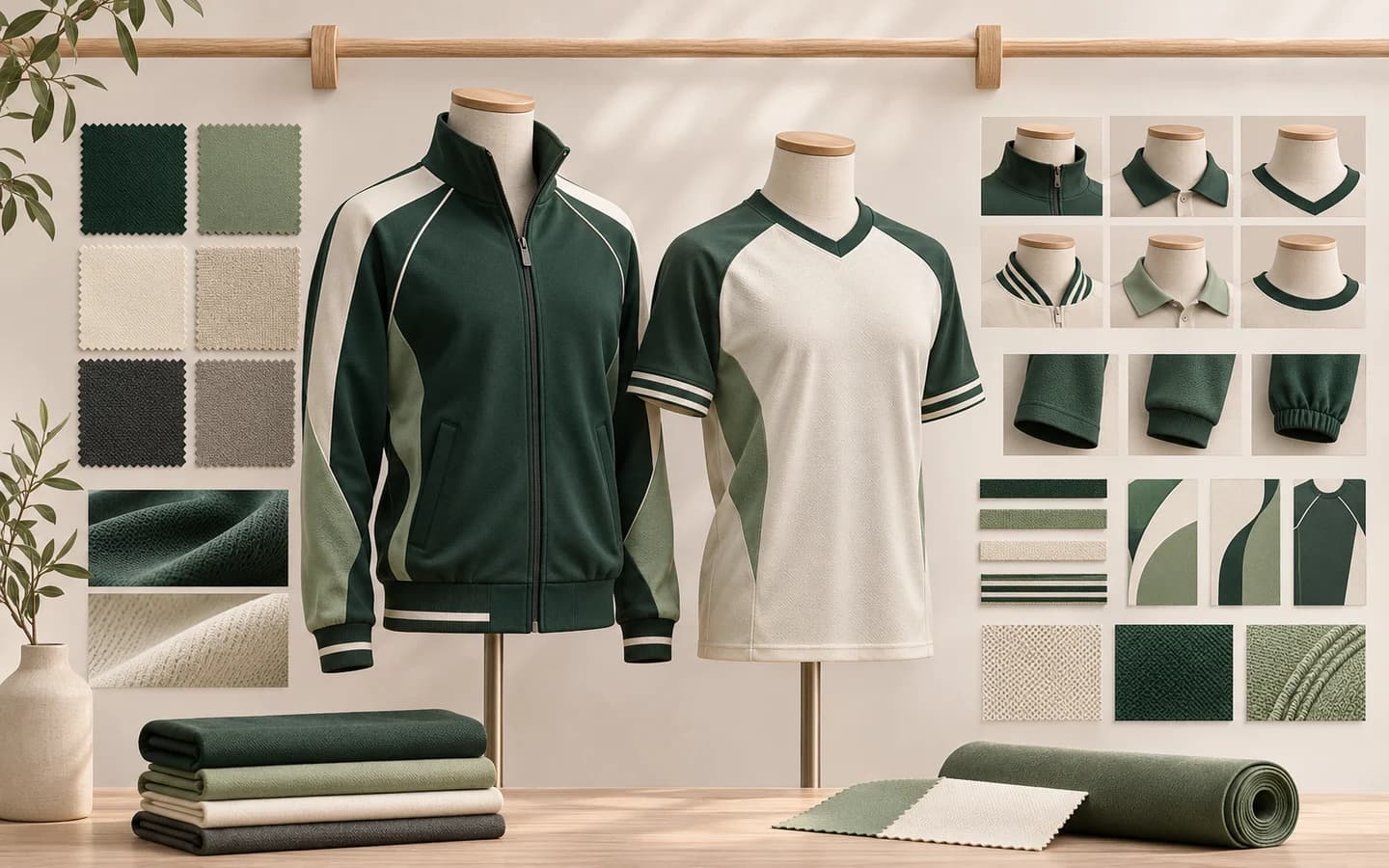
Changeable product zones are clearly defined so customers make only producible design decisions.
Manage product type, fit, sleeves, collars and complementary components.
Offer fabric grade, texture, panel colour and trims from your palette.
Provide patterns, logos and uploads in approved product areas.
Collect personal text, numbers, sizes and quantities for team orders.
The customer selects model and fabric, colours the panels, adds a logo and number in approved zones, then completes the size-and-quantity matrix.
| Customer choice | 3D response | Rule or output |
|---|---|---|
| Model and collar | Garment geometry | Collection and fit compatibility |
| Panel colours | Regional material change | Palette and colour limits |
| Logo and number | Print surface | File and safe-area checks |
| Sizes and quantities | No visual change | Order matrix and total |
The visual and scenario illustrate Viscore’s textile and uniform approach; they do not represent a published customer project.
Keep the visual design and structured production data in the same record.
Separate panels, print areas and changeable components in the 3D model.
Define fabrics, colours, print methods and minimum-order conditions.
Pass visual previews, text, uploaded files and size quantities to sales.
Questions about design and ordering.
Yes. File type, size and permitted print area can be limited, with production checks handled separately.
Text fields can preview names and numbers with controlled fonts, character limits and placement.
Yes. A team order can include a table of sizes, names, numbers and quantities.
We prepare web materials from reference imagery and physical characteristics, while clearly noting that screen appearance does not replace a physical sample.
Share your models, fabric palette and graphic rules. We’ll define the first product flow.